The modeling industry in 2026 is bigger, more fragmented, and more accessible than at any point in its history. The "modeling" of even 10 years ago was a substantially narrower business: agency mediated bookings concentrated in fashion, advertising, and trade shows, with a relatively small full time professional pool. The current landscape includes that traditional segment plus a much larger periphery: brand activation work, social media driven creator partnerships, subscription content platforms, and direct-to-client marketplaces that didn't exist meaningfully a decade ago.
The honest answer to "how big is the modeling industry" is that it depends entirely on what you count. This article breaks down the current segments, the realistic scale of each, and where models who treat modeling as a business actually earn their living in 2026.
The major segments of the modern industry
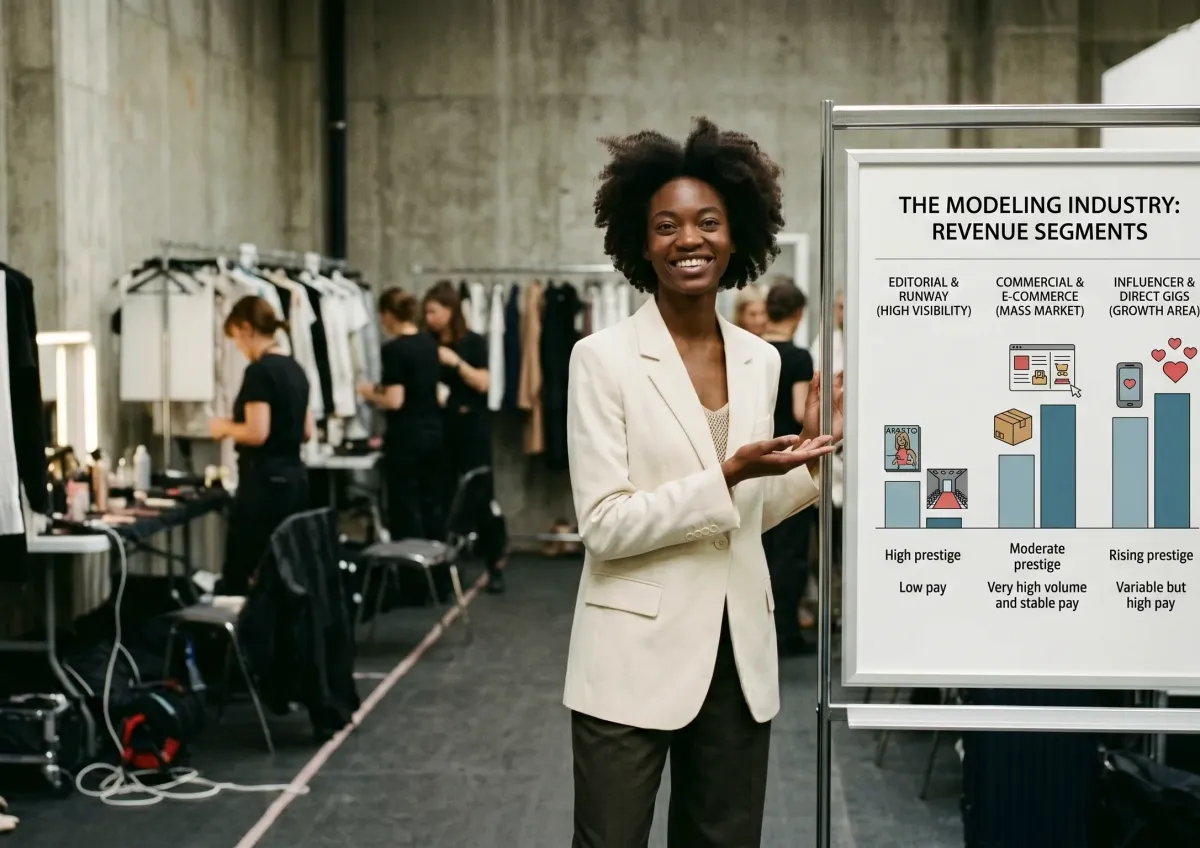
Fashion and editorial. The traditional segment: runway shows, magazine editorials, lookbook campaigns, fashion advertising. This is what people picture when they hear "modeling," but it's actually a smaller share of total industry bookings than the public imagines. Concentrated in NYC, LA, Miami, Paris, Milan, London, Tokyo. Agency mediated almost exclusively. Career compounds slowly but builds the most durable professional reputation.
Promotional and brand activation. The largest segment by booking volume in the United States. Trade shows, conventions, brand activations, product launches, sampling programs, mobile tour activations. Most professional models book most of their work here. Less prestigious than fashion but pays consistently and provides steady week to week work for active models.
Commercial and advertising. Print and video advertising, catalog work, e-commerce product modeling, in-store campaign assets. The work is bread and butter for models who can deliver clean commercial looks. E-commerce specifically has grown significantly as direct-to-consumer brands proliferated; many models now book consistent e-commerce work without ever doing traditional editorial.
Social media and influencer partnerships. Brand sponsored social posts, ambassadorships, paid creator partnerships. This segment didn't exist meaningfully before 2015 and is now one of the largest by total dollars spent. The economics are heavily skewed: a small number of high follower creators capture most brand deal spending, while the long tail of working models supplements traditional bookings with smaller scale creator partnerships.
Subscription content platforms. OnlyFans, Fansly, and similar platforms. For working models, this is a real revenue stream with real tradeoffs (see our companion article on OnlyFans for the economics and professional implications). Some models work in this segment exclusively; others use it as a supplement to traditional work; others avoid it entirely for casting pool reasons.
Specialty segments. Hand modeling, foot modeling, fitness modeling, plus size, alt/alternative, mature, ethnic specific casting, body double work, parts modeling for product photography, atmosphere modeling for film and TV background, trade show talent. Each is its own micro economy with its own rate norms and casting patterns.
Where most working models actually earn
The honest summary: the "starving model" narrative is mostly outdated. A model who treats it as a business, builds a real portfolio, works multiple segments rather than chasing fashion exclusively, and approaches social media as a paid channel rather than a vanity project can earn comparable income to many other freelance creative careers. The path is rarely linear and almost never includes the high profile editorial fame portrayed in media, but the working middle of the industry is genuinely active.
The shifts that matter most for 2026 entrants: monetization platforms (subscription content, creator partnerships, marketplace bookings) have become legitimate revenue alongside traditional agency work. Social media isn't optional anymore but it isn't a guaranteed payoff either. Geographic concentration has loosened post-2020 with remote casting and Atlanta's emergence as a major production hub alongside the traditional NYC/LA axis. Direct-to-client platforms like BookModels have made it possible to build real careers outside the traditional agency pipeline. The industry isn't a fixed thing being competed for by a static pool of models. It's a much larger and more fragmented business than the public picture suggests, and the models who treat it that way tend to do better than the ones who fixate on the narrow fashion editorial slice.